CPQ for custom products: when each fits.
Is Poly9 AI a CPQ? Partly. Poly9 AI configures, prices and quotes custom products from your own rules, which is the core CPQ job, and it answers buyers in plain language on your site. Classic CPQ tools go deeper on approval chains and ERP order entry. Poly9 AI removes the Excel rebuild, returns price on request when a rule is missing, and is priced per sales action instead of per seat.
Classic CPQ suites are built for large inside-sales teams: guided forms, multi-step approvals, ERP order entry and per-seat licences. Even so, 43% of manufacturers still quote from spreadsheets and 79% report quote-quality problems (Tacton, State of Manufacturing 2025).
They do not answer a buyer on your website at 6 p.m., and they do not stop the Excel rebuild after each RFQ. In a July 2025 survey of 200 US manufacturers, 71% took a day or more per quote. 88% had lost a deal to a slow quote (Aleran and TrendCandy).
Keep classic CPQ if orders must be entered and approved inside the ERP. Choose Poly9 AI if your team rebuilds quotes in Excel, buyers ask on your site, or price on request beats a guessed number.
The five verbs, plus four that decide it.
Rows the other category wins stay in. Swipe the table on a phone.
| What matters | CPQ tools | Poly9 AI |
|---|---|---|
| Answer | A rep looks the configuration up and reads it back to the buyer, during business hours. | Answers the buyer from your catalog on your site, in chat or at the booth, at 6 p.m. |
| Configure | Guided forms and dropdowns; compatibility enforced by admin-maintained rules. | Plain language: “walnut frame, COM grade F, king.” Your rules refuse what does not fit. |
| Price | Admin-maintained price tables. A missing rule breaks the quote or the rep guesses. | Cost recipes and grade matrices in plain language. A missing rule returns price on request. |
| Quote | A line-item PDF from a template, often rebuilt in Excel before it is sent. | No Excel rebuild. The buyer opens the quote on their phone and approves it in one tap. |
| Present | Out of scope. Decks and presentations live in other tools. | Renders the product in the chosen options and builds a priced collection from a mood board. |
| Approvals and ERPThey win this row | Multi-step, delegated approval chains and validated order entry into the ERP. | One internal approval before the quote goes out. ERP order entry stays with your CPQ or ERP. |
| Learns your business | Rules are static until the admin updates them. | Learns from every quote which options sell together and which rules are missing. |
| Pricing model | Per seat, per year. A designer who quotes twice a week costs the same as a full-time rep. | Per sales action. One credit per action, $100 buys a thousand, everyone on the team included. |
| Time to first quote | Weeks to months: discovery, rule migration, admin training, ERP integration. | Same day with a sample catalog. Two to five days to load a full price book and cost recipes. |
Category behavior is described in general terms; specific products vary. Poly9 AI behavior is as shipped in September 2026.
The five steps. Price comes from approved rules, or returns price on request.
Why the differences matter.
Classic CPQ assumes a sales rep at a keyboard during business hours. The buyer asks the rep, the rep drives the guided forms, the CPQ produces the output. Poly9 AI assumes the buyer is asking in plain language on your website, on a showroom floor or at a trade show booth, and answers from your catalog. For custom products whose buyers do not wait for 9 a.m., that difference decides the sale.
Both configure and enforce compatibility. Classic CPQ does it through admin-maintained forms: dropdowns, conditionals, validation rules that break when the admin has not anticipated the combination. Poly9 AI enforces compatibility inside the cost recipes you write in plain language, so “washdown-rated motor without a stainless enclosure” is refused with the reason before a price appears. Ask for an option you have not priced and it says price on request.
This is the line between an honest quote and a hopeful one. Classic CPQ prices from rule tables, and when a rule is missing the quote fails or the rep rebuilds it in Excel with a guessed number. Poly9 AI prices from your cost recipes and grade matrices through one engine. When the rule is missing it returns price on request and drafts the request for your estimator. It never guesses.
The Excel rebuild is where CPQ value leaks for custom products. The CPQ produces a line-item document; your team exports it, fixes the formatting, adds the options the CPQ does not know, adjusts the guess and emails a PDF. That is how 43% of manufacturers end up quoting from spreadsheets (Tacton, State of Manufacturing 2025). Poly9 AI sends the quote itself: the buyer opens it on the train home, sees the product in the chosen options, approves in one tap and replies in the thread.
Presentation is outside classic CPQ; it lives in decks and separate tools. For custom products the render usually sells before the number does. Poly9 AI renders your product in the chosen options from your materials library, turns a mood board into a priced collection and hands the buyer one link. A cabinet dealer quotes nine windows and a door for a whole house in one collection. A fabric house shows eight colorways of a king duvet, each priced from its grade.
Here the CPQ wins. Delegated approval chains, credit checks and validated order entry into the ERP are what classic CPQ suites were built for, and Poly9 AI does not replace them. A Poly9 AI quote can require one internal approval before the buyer sees it, and the approved quote becomes an order in Projects. If your policy needs more steps than that inside the ERP, keep the CPQ for order entry and put Poly9 AI in front of it.
A CPQ knows what the admin programmed. Poly9 AI learns from every question, quote and collection: which buyer prefers grade F when the upcharge is small, that nailheads usually go with box pleats in your quotes, that one rep always forgets to ask about the wood species. The cost recipes are still yours and still enforced. The memory layer suggests what to ask next.
Per-seat pricing punishes companies whose quoting is done by designers, dealers and occasional reps. A showroom with twenty designers who each send two quotes a week pays for twenty seats, and most of them sit idle. Poly9 AI is one credit per sales action, so the cost follows the quotes. $100 buys a thousand credits, everyone on your team is included, and four reps sending 30 quotes a week use about 500 credits a month.
CPQ implementation is a project: weeks to months of discovery, rule migration, admin training, rollout and ERP integration. Poly9 AI is an account. Create it, upload your catalog or start with your industry’s sample catalog, write the first cost recipe and send the first certified quote in the same session. A 37,400-SKU fabric line with grade matrices loaded in one day once the files were in hand.
- Orders must be entered and approved inside the ERP, and the CPQ is the validated front door.
- Policy requires multi-step approval chains with delegated authority.
- A dedicated admin maintains rule sets that change every week.
- Your sellers are a large, trained inside-sales team at desks, not designers, dealers or buyers on your site.
- Exact CAD-level geometry must be validated before any price can exist.
- Your team rebuilds CPQ output or RFQ responses in Excel before a quote goes out.
- Buyers ask on your website, at trade fairs or in showrooms, outside business hours.
- Price on request beats a guessed number that costs you the order.
- Quoting is done by designers, dealers, occasional reps or buyers themselves.
- The render and the mood board sell before the spreadsheet does.
- You want to pay per quote sent, not per seat provisioned.
Many custom manufacturers keep classic CPQ for ERP order entry and approvals and put Poly9 AI in front of it. The buyer or rep asks in plain language. Poly9 AI configures and prices from your rules, sends the quote without an Excel rebuild, and the approved order goes into the CPQ or ERP for entry and approval.
Ask for an option you have not priced.
Whatever you compare it with, run this on your own catalog. Poly9 AI prices from your recipes and matrices through one engine, and when the rule is missing it says “price on request” and drafts the request. The tool that produces a plausible number instead is the one that costs you an order.
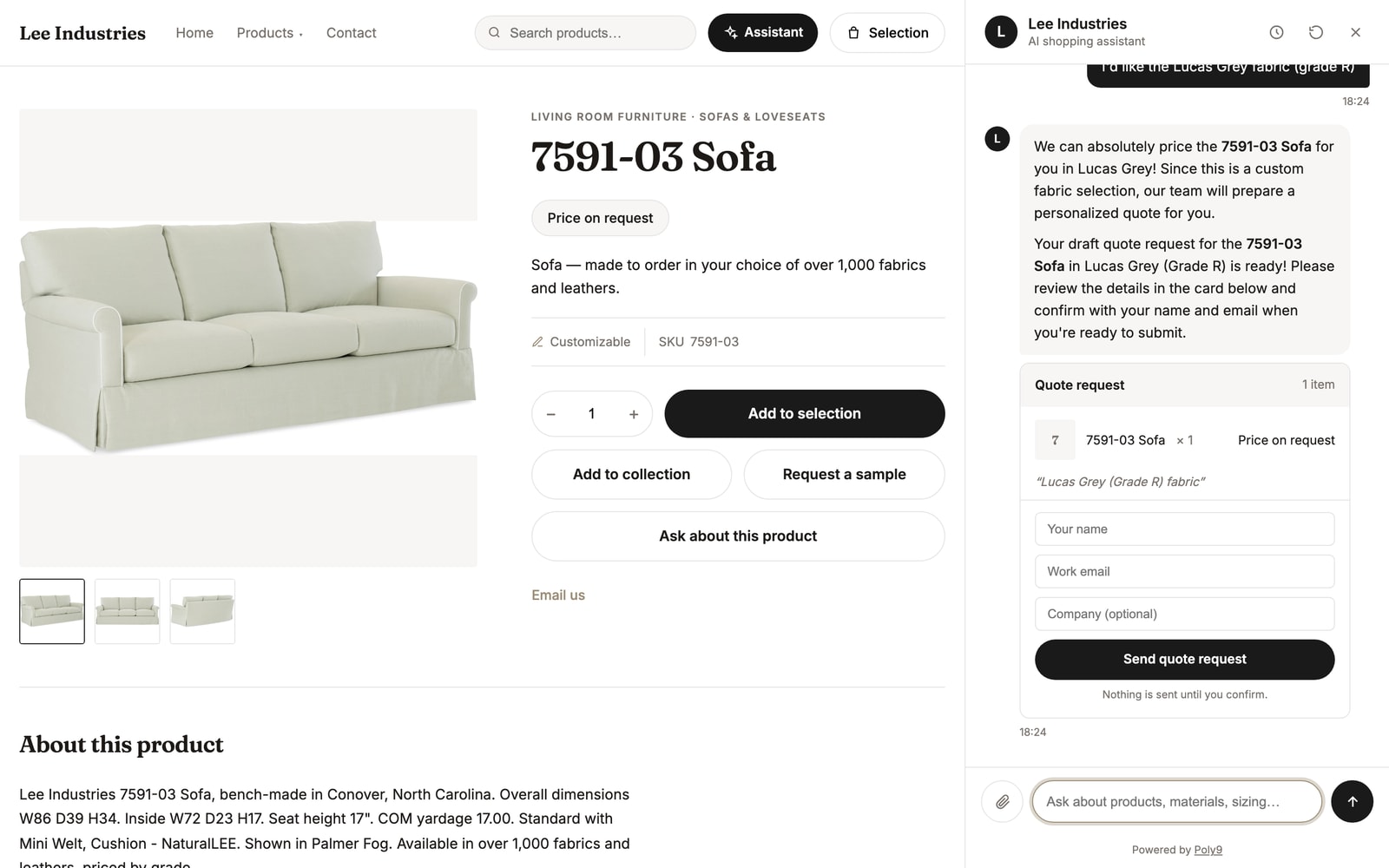
A fabric with no rule: the assistant drafts the quote request marked price on request. Real storefront.
Questions about CPQ tools.
Is Poly9 AI a CPQ for custom manufacturers?
Does it stop the Excel quote rebuild?
What happens when a pricing rule is missing?
Can it read our existing CPQ or ERP pricing rules?
What about multi-step approval workflows?
Our CPQ vendor stopped selling it. What now?
Why is there no per-seat pricing?
Can buyers configure and quote on our website?
- Tacton, State of Manufacturing 2025: 43% of manufacturers quote from spreadsheets; 79% report quote-quality problems
- Aleran and TrendCandy, survey of 200 US B2B manufacturing decision-makers, July 2025: 71% take a day or more per quote; 88% have lost a deal to a slow quote
- Salesforce, CPQ end-of-sale notice, 27 March 2025
- Poly9 AI plan catalog, September 2026
Start free. Judge it on your own catalog.
Create your account, add your catalog or start with your industry’s sample catalog, and ask the question you would ask the other tool. 250 sales actions free, no card, and the account stays yours.