The configurator builds it. Poly9 AI sells it.
Product configurator vs Poly9 AI: which do you need? Usually both. A product configurator validates every dimension and produces the factory order: jamb depth, rough opening, bill of materials. Poly9 AI sits in front of it. It answers the buyer’s plain-language question, prices from your rules in the buyer’s currency, says price on request when a rule is missing, and sends a quote the buyer approves on their phone.
Configurators are strong where the factory needs exact geometry: every dimension validated, a bill of materials and shop-floor output at the end.
They ask for the jamb depth before they show a price, and they speak the factory’s language. Dealers re-key the homeowner’s list into them after the visit, and the configurator prices the unit only: no install, no delivery, no buyer’s currency.
Keep the configurator for the factory order. Choose Poly9 AI for the conversation in front of it: plain language, an installed total from your rules, price on request when a rule is missing, a quote the same visit.
The five verbs, plus four that decide it.
Rows the other category wins stay in. Swipe the table on a phone.
| What matters | product configurators | Poly9 AI |
|---|---|---|
| Answer | Does not answer questions. It takes inputs. | Answers the buyer’s question first, then configures from the answer. |
| ConfigureThey win this row | Every dimension validated, in the factory’s terms, down to the bill of materials. | The options a buyer names, in their words, with your rules refusing what does not fit. |
| Price | The factory’s unit price, usually without install, delivery or dealer lines. | The unit from the factory’s rules plus the dealer’s own lines, one total in the buyer’s currency. |
| Quote | An order form for the factory. | A quote the homeowner approves on their phone the same visit. Price on request when a rule is missing. |
| Present | A CAD-style preview of the unit. | A render in the setting, labeled, and a priced collection for the whole project. |
| Factory outputThey win this row | Cut lists, BOM and shop-floor data the plant can build from. | Not the job. The approved order goes to the factory system. |
| Learns your business | Static: the rules the factory published. | Learns which options each dealer and each buyer asks for. |
| Pricing model | Licensed by the factory, often per dealer seat. | One credit per sales action, everyone on the team included. |
| Time to first quote | An evening of re-keying for a dealer new to the tool. | The same visit, once the dealer’s own pricing lines are written. |
Category behavior is described in general terms; specific products vary. Poly9 AI behavior is as shipped in September 2026.
The five steps, with configure and render on your own options and materials.
Why the differences matter.
A configurator is a form. It does not answer “can I get it in black with argon?”; it waits for you to fill in the fields. Poly9 AI answers the question, then fills the fields from the answer.
Here the configurator wins. It validates the geometry the factory needs, every dimension, and Poly9 AI does not try to replace that. Poly9 AI validates the options a buyer names with the same compatibility rules, and the approved order goes to the factory system afterwards.
A factory configurator prices the unit. Poly9 AI prices the unit from the factory’s rules, adds the dealer’s own lines for install and delivery from the dealer’s recipes, and shows one total in the buyer’s currency. When a rule is missing it says price on request and drafts the request. It never estimates.
The output of a configurator is an order for the plant. The output of Poly9 AI is a quote the homeowner approves at the kitchen table, on their phone, before the dealer has put their coat on. Every line is traceable to its rule, and the order is created from the approval.
A configurator previews the unit. Poly9 AI renders it in the elevation, labeled as a render, and puts nine windows and a door into one priced collection for the whole house.
Cut lists, bills of materials and shop-floor data are the configurator’s job and stay there. Poly9 AI hands the approved, configured order to the factory system and gets out of the way. If your factory has no configurator at all, Poly9 AI is the configurator and the sales layer at once, priced from your recipes.
A configurator knows the factory’s rules. Poly9 AI learns that this dealer always quotes black exteriors and that this homeowner asked about argon twice.
Factory configurators are licensed to dealers by the factory, often per seat. Poly9 AI is one credit per sales action, so a dealer pays for the quotes they send and everyone in the shop is included.
A dealer new to a configurator spends an evening re-keying. Poly9 AI quotes the same visit once the dealer’s install and delivery lines are written, which takes an afternoon.
- The factory order: exact geometry, bill of materials, shop-floor output.
- Products where every dimension must be validated before a price exists.
- Dealers who are trained on it and quote from a desk.
- A factory that already licenses it to every dealer.
- The conversation before the order: the homeowner’s question at the kitchen table.
- One installed total from the factory’s rules and the dealer’s own lines, in the buyer’s currency.
- A quote approved on the buyer’s phone the same visit, and price on request when a rule is missing.
- A render in the setting and a priced collection for the whole project.
This is the normal arrangement. Poly9 AI is the dealer’s sales AI in front of the factory configurator: plain language in, installed quote out, and the configured order handed to the factory system after the homeowner approves. The windows, doors and millwork page shows the whole flow.
Ask for an option you have not priced.
Whatever you compare it with, run this on your own catalog. Poly9 AI prices from your recipes and matrices through one engine, and when the rule is missing it says “price on request” and drafts the request. The tool that produces a plausible number instead is the one that costs you an order.
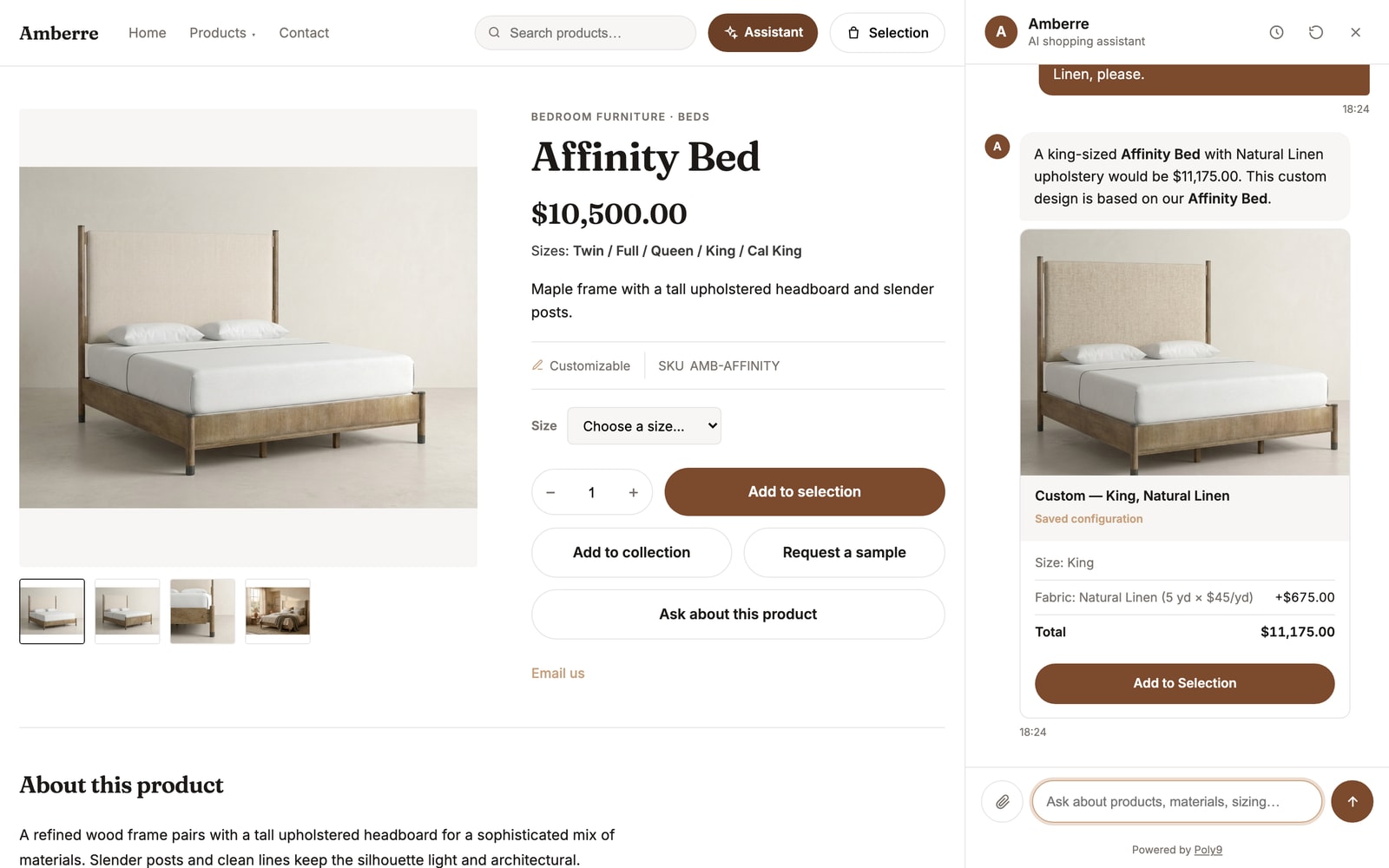
Size and fabric chosen, the bed priced from the maker’s recipe, configuration saved. Real storefront.
Questions about product configurators.
Does Poly9 AI replace our configurator?
How do the factory’s rules get into Poly9 AI?
Can a homeowner use it directly?
What about products with no configurator at all?
What does “price on request” mean?
Can it quote in the buyer’s currency?
- Poly9 AI windows, doors and millwork industry page, September 2026
- Poly9 AI plan catalog and trial terms, September 2026
Start free. Judge it on your own catalog.
Create your account, add your catalog or start with your industry’s sample catalog, and ask the question you would ask the other tool. 250 sales actions free, no card, and the account stays yours.